
What is AI Automation? AI Automation Explained (2026)
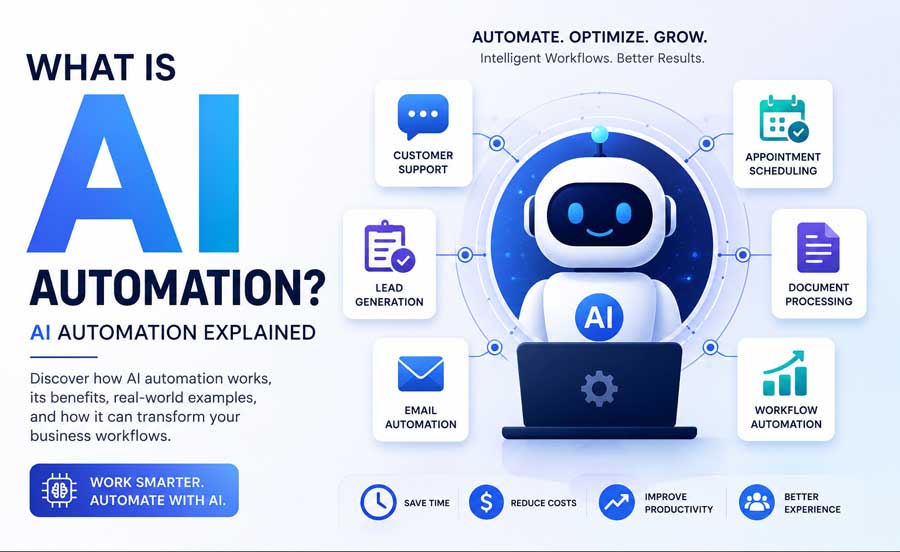
Artificial Intelligence (AI) is changing how businesses work. From answering customer questions to scheduling appointments and processing repetitive tasks, AI is helping companies save time, reduce costs, and improve customer experiences.
This is known as AI Automation.
If you're new to the concept, this guide explains what AI automation is, how it works, its benefits, and how businesses of all sizes can use it.
What is AI Automation?
AI Automation is the use of Artificial Intelligence to automate tasks that normally require human effort.
Unlike traditional automation, which follows predefined rules, AI automation can understand language, analyze information, make decisions, and continuously improve its responses based on the data it receives.
For example, instead of manually replying to customer inquiries, an AI assistant can understand the question, retrieve the correct information, and provide an accurate response within seconds.
How Does AI Automation Work?
Most AI automation systems follow four simple steps:
- Receive Input – A customer sends a message, submits a form, or triggers an event.
- Analyze Information – AI understands the request using natural language processing (NLP) and retrieves relevant information.
- Take Action – The AI performs tasks such as answering questions, updating a CRM, sending emails, or booking appointments.
- Deliver Results – The customer or your team receives the completed response or action automatically.
This entire process happens within seconds and often without manual intervention.
AI Automation vs Traditional Automation
Although both automate work, they are very different.
| Traditional Automation | AI Automation |
|---|---|
| Rule-based workflows | Learns from context and data |
| Requires exact conditions | Understands natural language |
| Limited decision-making | Makes intelligent decisions |
| Static workflows | Adapts to different scenarios |
| Best for repetitive tasks | Handles repetitive and complex tasks |
Benefits of AI Automation
Businesses are adopting AI automation because it delivers measurable improvements.
- Saves hours of manual work
- Provides 24/7 customer support
- Responds instantly to customer inquiries
- Reduces operational costs
- Improves productivity
- Minimizes human errors
- Generates and qualifies leads automatically
- Enhances customer experience
- Scales without hiring additional staff
Real-World Examples of AI Automation
Customer Support
AI chatbots answer common questions, resolve basic issues, and forward complex requests to human agents.
Appointment Scheduling
AI can check availability, schedule meetings, send reminders, and handle cancellations automatically.
Sales & Lead Qualification
AI assistants capture customer information, qualify leads, and assign them to the right sales representative.
Email Automation
AI generates personalized responses, summarizes conversations, and sends follow-up emails automatically.
Document Processing
Businesses use AI to extract information from invoices, contracts, PDFs, and forms, eliminating hours of manual data entry.
Who Can Benefit from AI Automation?
Almost every business can benefit from AI automation, including:
- Healthcare clinics
- Law firms
- Real estate agencies
- Marketing agencies
- E-commerce stores
- Educational institutions
- Restaurants
- Financial services
- SaaS companies
- Professional service providers
If your business performs repetitive tasks every day, AI automation can help streamline operations and improve efficiency.
Popular AI Automation Tools
Several platforms make it easy to build AI-powered workflows.
- OpenAI
- n8n
- Make.com
- Zapier
- Claude
- LangChain
- Pinecone
- Supabase
- Google Gemini
These tools integrate with CRMs, websites, databases, email providers, and hundreds of other business applications.
AI Automation + RAG = Smarter AI
Modern AI systems become even more powerful when combined with Retrieval-Augmented Generation (RAG). Instead of relying only on model training, RAG allows AI to retrieve information from your own website, FAQs, documents, or knowledge base before generating a response.
This leads to more accurate answers, fewer AI hallucinations, and a better customer experience.
If you're new to RAG, read our guide: What is RAG? A Beginner's Guide (2026).
How Webefy Today Can Help
At Webefy Today, we help businesses automate repetitive tasks using intelligent AI solutions. Whether you need an AI chatbot, lead qualification system, customer support assistant, or appointment booking automation, our AI Automation Services can help.
Need to automate appointment scheduling? Explore our AI Booking Agent, which answers customer questions and books appointments automatically.
Frequently Asked Questions
Is AI automation only for large businesses?
No. Businesses of all sizes can automate customer support, lead generation, email follow-ups, and scheduling using AI.
Does AI automation replace employees?
No. AI automation handles repetitive tasks so employees can focus on strategic and creative work.
Is AI automation expensive?
Not necessarily. Many businesses start with one workflow and expand as they experience the return on investment.
Can AI automation work with my existing software?
Yes. Most AI automation platforms integrate with websites, CRMs, calendars, email providers, payment systems, and many other business tools.
Final Thoughts
AI automation is no longer a futuristic concept—it's becoming an essential part of modern business operations.
By automating repetitive tasks, improving customer support, and streamlining workflows, businesses can save time, reduce costs, and deliver better customer experiences.
Whether you're just starting with AI or looking to expand your existing automation strategy, adopting AI automation today can give your business a competitive advantage in 2026 and beyond.