
What is RAG? A Beginner's Guide (2026)
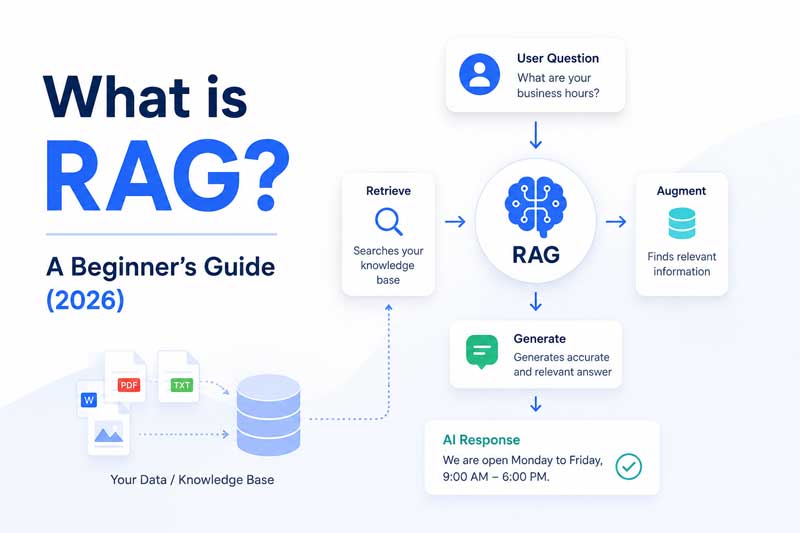
Artificial Intelligence has become incredibly powerful, but it still has one major limitation—it can sometimes provide incorrect or outdated information. That's where RAG (Retrieval-Augmented Generation) comes in.
If you've heard the term but aren't sure what it means, this beginner-friendly guide will explain it in simple language.
What is RAG?
RAG (Retrieval-Augmented Generation) is an AI technique that allows chatbots and AI assistants to retrieve information from your own data before generating a response.
Instead of relying only on what the AI learned during training, a RAG system searches your documents, website, FAQs, or knowledge base to find the most relevant information before answering.
Think of it like this:
- Without RAG: The AI answers from memory.
- With RAG: The AI looks up the correct information first, then answers.
This makes AI responses more accurate, reliable, and up to date.
How Does RAG Work?
RAG follows a simple process:
- A user asks a question.
- The AI searches your business data or knowledge base.
- It retrieves the most relevant information.
- The AI generates an answer based on that information.
For example, if someone asks, "What are your business hours?", the AI retrieves the latest information from your website instead of guessing.
Why is RAG Important?
Traditional AI models can sometimes make up facts, often called AI hallucinations. RAG significantly reduces this problem by grounding responses in your actual business information.
Benefits of RAG include:
- More accurate answers
- Up-to-date information
- Reduced AI hallucinations
- Better customer support
- No need to retrain the AI whenever your content changes
Where is RAG Used?
Businesses across industries use RAG to power smarter AI assistants.
- Customer support chatbots
- Company knowledge bases
- Employee assistants
- Product documentation search
- FAQ assistants
- Healthcare and legal document search
- E-commerce customer support
A Simple Example
Imagine you own a dental clinic.
A customer asks, "Do you offer teeth whitening, and how much does it cost?"
A RAG-powered chatbot searches your latest services and pricing before responding, ensuring customers receive accurate information every time.
RAG + AI Automation
RAG becomes even more powerful when combined with AI automation. A smart AI assistant can answer customer questions, collect leads, schedule appointments, and automate repetitive tasks using your business data.
If you're planning to automate your customer support or appointment scheduling, explore our AI Automation Services or see how our AI Booking Agent can answer questions and book appointments automatically.
Is RAG Right for Your Business?
If your business has FAQs, product information, service pages, documents, policies, or internal knowledge, RAG can help you build an AI assistant that delivers accurate, business-specific answers instead of generic responses.
Final Thoughts
RAG is one of the most important technologies behind modern AI assistants in 2026. By allowing AI to retrieve information from your own knowledge base before answering, it makes chatbots smarter, more trustworthy, and more useful for businesses.
Whether you're building a customer support chatbot, an internal knowledge assistant, or an AI booking system, RAG is the technology that helps deliver accurate and reliable conversations.
Frequently Asked Questions
What does RAG stand for?
RAG stands for Retrieval-Augmented Generation. It allows AI to retrieve relevant information before generating a response.
Does RAG train the AI?
No. RAG doesn't retrain the AI model. Instead, it retrieves information from your existing documents or knowledge base whenever a question is asked.
Why is RAG better than a traditional chatbot?
Traditional chatbots rely on predefined responses or AI memory. RAG-powered chatbots use your latest business information, making their answers far more accurate and reliable.