
Common RAG Mistakes and How to Avoid Them (2026)
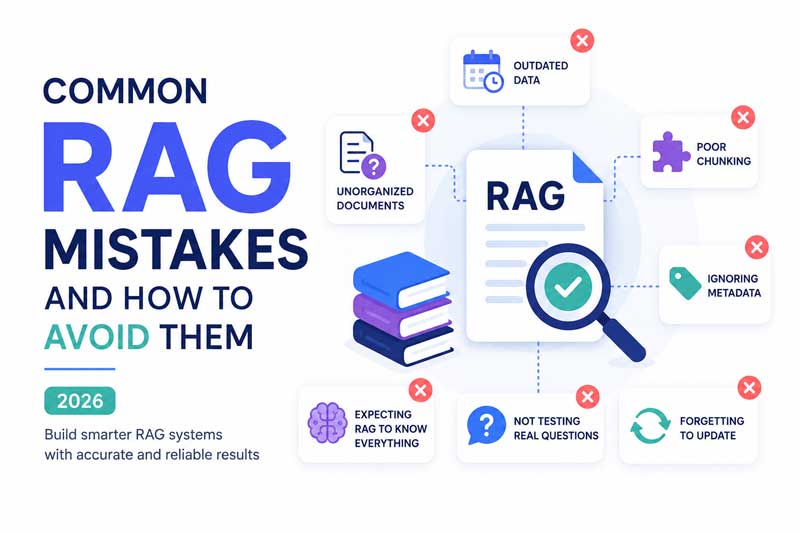
Retrieval-Augmented Generation (RAG) has become one of the most effective ways to build accurate AI chatbots and assistants. However, simply connecting an AI model to your documents doesn't guarantee good results.
Poor data quality, incorrect retrieval settings, and weak prompts can all lead to inaccurate responses. Here are the most common RAG mistakes—and how to avoid them.
1. Using Outdated or Incorrect Data
A RAG system is only as good as the information it retrieves. If your documents contain outdated pricing, old policies, or incorrect information, your AI will confidently return the wrong answers.
How to avoid it:
- Keep your knowledge base updated.
- Remove duplicate and outdated documents.
- Review important content regularly.
2. Uploading Unorganized Documents
Many businesses upload hundreds of PDFs and expect the AI to understand everything. Messy, duplicated, or poorly structured documents make it harder for the AI to find the right information.
How to avoid it:
- Organize documents by topic.
- Use clear headings.
- Remove duplicate files.
- Break large documents into logical sections.
3. Poor Document Chunking
Large documents shouldn't be stored as one huge block of text. If chunks are too large, the AI retrieves unnecessary information. If they're too small, important context is lost.
How to avoid it:
- Split documents into meaningful sections.
- Keep related information together.
- Test different chunk sizes for better results.
4. Ignoring Metadata
Without metadata, your AI searches every document equally—even when only a specific department or product is relevant.
How to avoid it:
- Add categories and tags.
- Include product names.
- Store document dates.
- Organize by department or language.
5. Expecting RAG to Know Everything
RAG only knows what exists in your knowledge base. If the information isn't available, the AI can't retrieve it.
How to avoid it: Continuously expand your knowledge base with FAQs, documentation, policies, and product information.
6. Not Testing Real User Questions
Many teams only test simple questions during development. Real customers often ask questions in unexpected ways.
How to avoid it: Test your chatbot using real customer conversations and continuously improve it based on feedback.
7. Forgetting to Update the Knowledge Base
Businesses constantly update products, pricing, and services. If your knowledge base isn't maintained, your AI quickly becomes outdated.
How to avoid it: Create a simple process to update your knowledge base whenever business information changes.
8. Using RAG Without AI Automation
RAG becomes much more powerful when combined with AI automation. An AI assistant can answer customer questions, capture leads, schedule appointments, send follow-up emails, and automate repetitive tasks.
If you're planning to automate customer support or appointment scheduling, explore our AI Automation Services or see how our AI Booking Agent can answer customer questions and book appointments automatically.
Final Thoughts
RAG is a powerful technology, but success depends on more than choosing the right AI model. Clean data, organized documents, proper chunking, and regular updates are essential for accurate responses.
If you're new to RAG, we recommend reading our What is RAG? A Beginner's Guide (2026) to understand the fundamentals before building your own AI assistant.
Frequently Asked Questions
Can RAG work without a vector database?
Yes, but most modern RAG systems use vector databases because they provide faster and more accurate semantic search.
Does RAG eliminate AI hallucinations?
No. RAG significantly reduces hallucinations by grounding AI responses in your own data, but it cannot eliminate them completely.
Is RAG suitable for small businesses?
Absolutely. Any business with FAQs, product information, service pages, or internal documentation can benefit from a RAG-powered AI assistant.